Every summer, millions of people queue for the same handful of landmarks. They shuffle past the Tower of London, squeeze onto the path up Snowdon, and stand shoulder to shoulder on the promenade at Brighton. It’s not that those places aren’t worth seeing. It’s that the crowds change what you experience. You end up watching other visitors instead of the view.
Hidden gems tourists usually miss tend to sit within a short drive of those famous spots. They’re quieter, cheaper, and often stranger in the best way. What follows are twelve of them, split into coast, countryside, and city, with one clear reason each is worth the detour.
Coastal Hidden Gems Tourists Usually Miss
The British coastline is roughly eleven thousand miles long, and the vast majority of visitors cluster around maybe twenty of them. Move half an hour along the shore in either direction and the atmosphere shifts completely.
1. Porth Joke, Cornwall
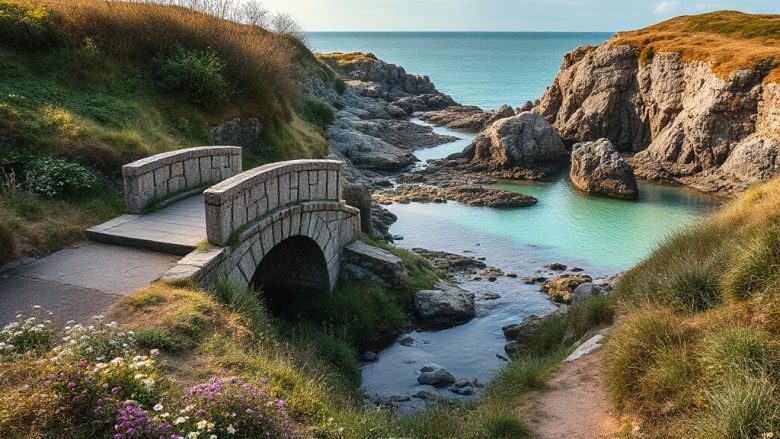
Everyone photographs the turquoise water at Porthcurno and the Minack Theatre perched above it. Ten minutes north, a narrow lane drops down to Porth Joke, a National Trust cove with no car park, no cafe, and no signage worth mentioning. You walk in through a field, arrive at two small sandy bays split by a rocky outcrop, and often find fewer than a dozen people there even in August. Go at low tide, when the rock pools along the northern edge open up and you can spend an hour finding crabs, anemones, and tiny shrimp without another soul nearby. Take everything you need with you, because there’s nothing to buy once you’re down there.
2. Covehithe, Suffolk
The Suffolk coast is famous for Southwold’s pier and its striped lighthouse, but drive fifteen minutes north and the road simply ends at the sea. Covehithe is a village that is slowly falling into the water, and the church of St Andrew stands half-ruined inside the shell of its own larger predecessor. You can walk through a gap in the church wall, stand among gravestones, and look out over a beach where the cliffs are disappearing at a rate of several metres a year. It’s eerie, beautiful, and almost always empty. Wear sturdy shoes, because the path down to the sand is uneven and the erosion means the route shifts from season to season.
3. Fall Bay, Gower
Rhossili Bay gets the postcards and the coach parties. Fall Bay, reached by walking west from the Rhossili headland for about twenty minutes, has no facilities and no easy access, which is exactly why it stays quiet. The beach is a mix of sand and flat limestone slabs, and at low tide you can walk around to a series of caves and a natural arch. Surfers know it, dog walkers know it, and almost nobody else does. Check tide times before you go, because the route around the headland disappears under water at high tide and there’s no shortcut back.
4. Cattersty Sands, North Yorkshire
Whitby and Robin Hood’s Bay pull the crowds, and rightly so. But a few miles up the coast, past the industrial skyline of Teesside, Cattersty Sands sits below the village of Skinningrove. It’s a long, quiet stretch of sand backed by low cliffs, with a small heritage centre in the village that tells the story of the local ironstone mining. The beach is rarely busy, the water is clean, and the walk along the clifftop toward Saltburn gives you views that feel far more remote than the map suggests. Parking is free and limited, which keeps the numbers down.
Countryside Hidden Gems Tourists Usually Miss
National parks get the attention, but some of the best walking in Britain happens in the gaps between them, in areas that never made it onto a marketing poster.
5. The Howgills, Cumbria
The Lake District draws millions of visitors a year to Windermere, Ambleside, and Keswick. Just east of the M6, the Howgill Fells rise in a series of smooth, rounded ridges that look more like a herd of sleeping animals than mountains. There are no lakes, no honeypot villages, and no crowds. The walking is steep but short, and on a clear day from the top of The Calf you can see the Yorkshire Three Peaks, the Lakeland fells, and the sea at Morecambe Bay all at once. Sedbergh, a small book town at the foot of the hills, makes a good base with a couple of pubs and a surprising number of second-hand bookshops.
6. The Machars, Dumfries and Galloway
Most visitors heading to Scotland drive straight past the southwest corner on their way to Glasgow or the Highlands. The Machars peninsula, south of Newton Stewart, is a low, green, quietly beautiful area with a coastline of rocky inlets, small beaches, and a scattering of early Christian sites. Whithorn Priory, one of the oldest Christian settlements in Scotland, sits at its southern tip, and the walk out to the Isle of Whithorn gives you views across to the Isle of Man on a clear day. Accommodation is cheap, roads are empty, and the local seafood is excellent.
7. The Clun Valley, Shropshire
The Shropshire Hills are an Area of Outstanding Natural Beauty, but most walkers head for the Long Mynd and Church Stretton. The Clun Valley, further south and west, is quieter and arguably prettier, with a river that meanders through small fields, ancient woodland, and villages built from dark local stone. Clun itself has a ruined Norman castle and a medieval bridge, and the Offa’s Dyke Path runs along the ridge above the valley. It’s the kind of place where you can walk for four hours and see more sheep than people.
8. The Berwyn Mountains, Powys
Snowdonia gets the crowds and the car park charges. The Berwyn range, further east and much lower, is peat bog, heather, and wide empty moorland with a handful of summits that rarely see more than a few walkers a day. The area around Llandrillo and Cynwyd has quiet lanes, small chapels, and a genuine sense of remoteness that’s hard to find elsewhere in Wales. Birdwatchers come for the hen harriers and red grouse, and the dark skies make it a good spot for stargazing on clear autumn nights.
City Hidden Gems Tourists Usually Miss
Cities reward anyone willing to walk ten minutes away from the main drag. The best bits are often free, small, and slightly odd.
9. The Postman’s Park, London
Two minutes from St Paul’s Cathedral, tucked between office buildings near the Museum of London, is a small public garden with a wall of ceramic tiles commemorating ordinary people who died saving others. The Watts Memorial, created in the late nineteenth century, tells stories of children rescued from fires, policemen struck by trains, and a woman who gave her life to save a stranger from a runaway horse. It’s free, usually almost empty, and one of the most moving spots in the city. Most Londoners have never heard of it.
10. The Northern Quarter’s Back Streets, Manchester
Everyone knows the Northern Quarter for its bars and street art, but the real pleasure is in the alleys behind the main streets, where old textile warehouses have been converted into small studios, record shops, and independent coffee places. Look for the faded painted signs on the brickwork advertising long-gone businesses. The area around Thomas Street and Oldham Street is best explored on a weekday morning, when it’s quiet and the shutters are up. It’s a ten-minute walk from Piccadilly Gardens and feels like a different city.
11. The Dean Village, Edinburgh
The Royal Mile and the Castle get the crowds, but walk fifteen minutes along the Water of Leith from Stockbridge and you arrive at Dean Village, a cluster of old milling buildings tucked into a steep valley below the city. The architecture is a mix of seventeenth-century cottages and nineteenth-century industrial buildings, and the river runs right through the middle. There’s a small green, a couple of bridges, and a path that continues along the water toward the Scottish Gallery of Modern Art. It’s peaceful, photogenic, and almost entirely ignored by tour groups.
12. The Ropewalks, Liverpool
Liverpool’s Albert Dock and the waterfront get the attention, but the Ropewalks district, just inland, is where the city’s independent side lives. The streets are named after the rope-making trade that once filled them, and the area now holds small galleries, record shops, and bars in converted warehouses. Bold Street runs through the middle and is one of the best streets in the country for independent food. It’s a short walk from the main shopping district and rewards anyone who takes the time to wander rather than follow the crowd.
None of these places will ever make a top ten list, and that’s precisely the point. Pick one, go on a weekday, and you’ll understand why the best travel memories rarely happen where the coaches park.